Module 1: Introduction to Data Analytics in Health and Safety
This module provides an overview of data analytics, its importance in health and safety management, and key concepts in business intelligence.
This course delves into Data Analytics for Health and Safety within the Business Intelligence context, designed for professionals seeking to optimize workplace safety through data-driven strategies. Ideal for safety officers, data analysts, and professionals interested in leveraging analytics for risk management with real-world applications and practical insights.
4.4/5
|96 reviews
|418 students enrolled
Comprehensive, industry-recognized certification that enhances your professional credentials
Self-paced online learning with 24/7 access to course materials for maximum flexibility
Practical knowledge and skills that can be immediately applied in your workplace
This module provides an overview of data analytics, its importance in health and safety management, and key concepts in business intelligence.
Participants will learn to visualize health and safety data effectively, interpret trends, and derive actionable insights for risk mitigation.
This module focuses on predictive analytics techniques to forecast potential health and safety risks and prevent incidents proactively.
Participants will explore how data analytics can be integrated into safety programs to enhance compliance, incident reporting, and safety culture.
This module includes real-world case studies and hands-on exercises to apply data analytics concepts to health and safety scenarios.
This programme includes comprehensive study materials designed to support your learning journey and offers maximum flexibility, allowing you to study at your own pace and at a time that suits you best.
You will have access to online podcasts with expert audio commentary.
In addition, you'll benefit from student support via automatic live chat.
Assessments for the programme are conducted online through multiple-choice questions that are carefully designed to evaluate your understanding of the course content.
These assessments are time-bound, encouraging learners to think critically and manage their time effectively while demonstrating their knowledge in a structured and efficient manner.
The demand for professionals skilled in data analytics for health and safety is on the rise. Graduates of this course can pursue diverse career paths in occupational health, safety management, risk analysis, and data-driven decision-making roles.
Career progression in this field offers opportunities for specialization in safety analytics, consulting roles, and leadership positions. Professional development pathways include certifications in data analytics, advanced safety management, and industry-specific accreditations.
Responsible for analyzing health and safety data, identifying trends, and recommending strategies for risk mitigation.
Focuses on integrating data analytics into safety programs, ensuring compliance, and optimizing safety performance.
Provides expert guidance on risk assessment, predictive modeling, and data-driven decision-making for safety enhancement.
In addition to job opportunities, graduates can benefit from networking events, professional certifications such as Certified Safety Professional (CSP), opportunities for further education in health and safety management, and industry recognition for expertise in data analytics for safety.
Safety Officer
"The course empowered me to use data analytics to proactively identify safety risks in the workplace, leading to effective risk management strategies."
Data Analyst
"I learned to interpret data trends for enhancing workplace safety measures, making data-driven decisions to improve overall safety protocols."
Health and Safety Specialist
"Implementing the data-driven strategies from this course has enabled me to continuously improve safety measures and develop robust risk assessment models."
Risk Management Consultant
"The practical insights gained helped me utilize business intelligence tools effectively for proactive safety management, enhancing overall safety protocols."
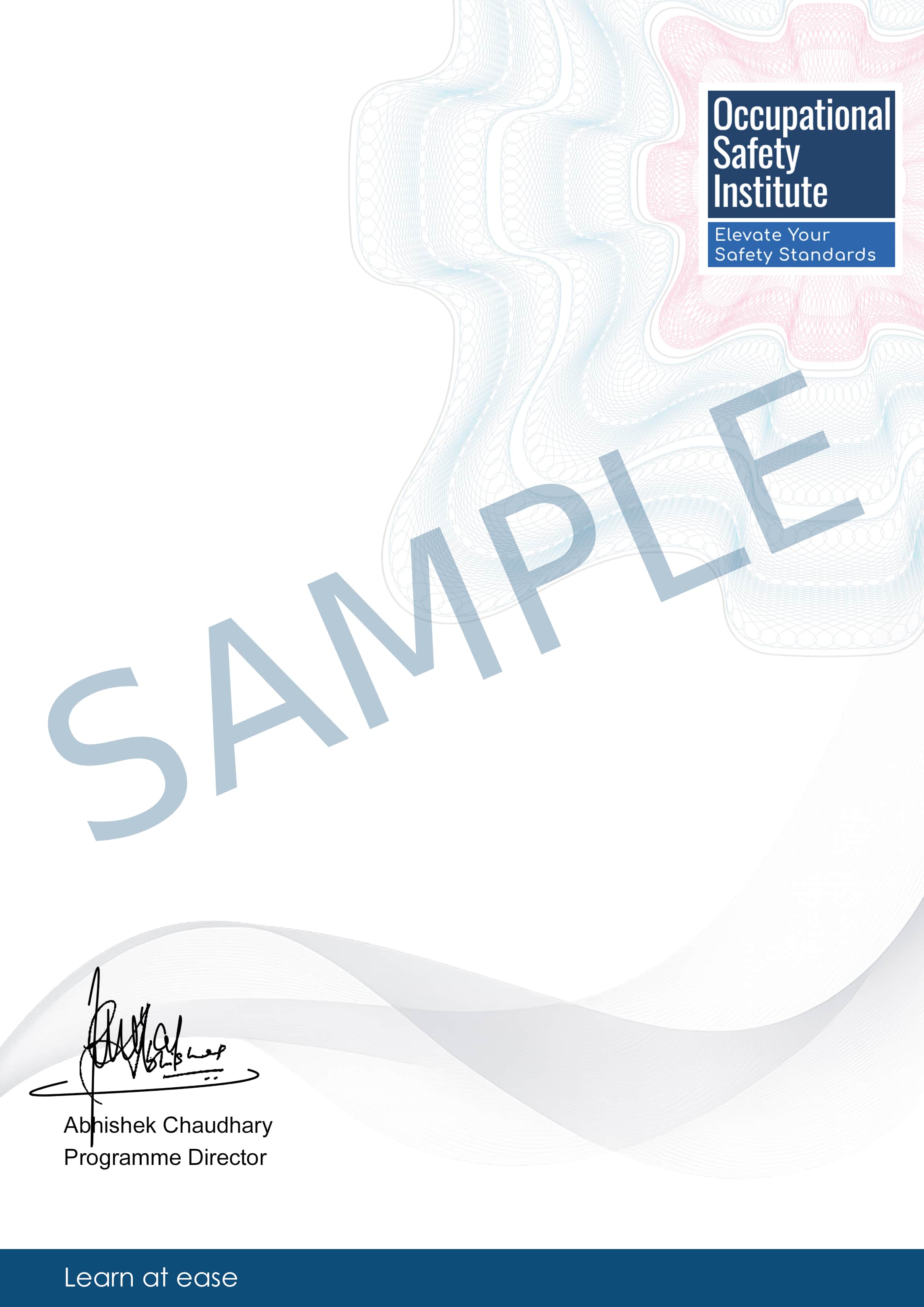
Upon successful completion of this course, you will receive a certificate similar to the one shown below:
Professional Certificate Data Analytics for Health and Safety in the Business Intelligence Context
is awarded to
Student Name
Awarded: April 2026
Blockchain ID: 111111111111-eeeeee-2ddddddd-00000
No specific prior qualifications are required. However, basic literacy and numeracy skills are essential for successful completion of the course.
The course is self-paced and flexible. Most learners complete it within 1 to 2 months by dedicating 4 to 6 hours per week.
This course is not accredited by a recognised awarding body and is not regulated by an official institution. It is designed for personal and professional development and is not intended to replace or serve as an equivalent to a formal degree or diploma.
This fully online programme includes comprehensive study materials and a range of support options to enhance your learning experience: - Online quizzes (multiple choice questions) - Audio podcasts (expert commentary) - Live student support via chat The course offers maximum flexibility, allowing you to study at your own pace, on your own schedule.
Yes, the course is delivered entirely online with 24/7 access to learning materials. You can study at your convenience from any device with an internet connection.
Comprehensive Electrical Safety Training
Our Comprehensive Electrical Safety Training course is desi…
Strategic Approaches to Health and Safety Legislation Adherence
This course offers strategic insights into health and safet…
Optimizing Food Safety Measures with Artificial Intelligence
This course focuses on leveraging Artificial Intelligence t…
Fashion Emotional Intelligence for Designers
A comprehensive course on 'Fashion Emotional Intelligence f…
Disclaimer: This certificate is not intended to replace or serve as an equivalent to obtaining a formal degree or diploma. This programme is structured for professional enrichment and is offered independently of any formal accreditation framework.